


A popular narrative in media and political circles over recent years has been that Brexit has badly damaged the UK’s productivity performance. This alleged damage is traced to a supposed reduction in economic ‘openness’ due to increased trade frictions with the EU. This narrative has been given semi-official sanction by repeated claims by the OBR that Brexit will reduce UK productivity by 4% relative to where it would have been if not for Brexit.
We have shown elsewhere that the OBR’s claims rest on a weak evidence base. Not only do they result from averaging the results of several old studies, some of which made very questionable assumptions, but they presuppose a link between openness and productivity which is empirically poorly supported.
The claim is also at variance with the actual UK data. There has, in fact, been no reduction in the UK’s economic openness as measured by the ratio of exports and imports to GDP (the preferred measure of Brexit critics). Nor is it easy to discern any change in the trend rate of labour productivity growth in the UK related to Brexit; rather, the big productivity slowdown in the UK dates to the period around the global financial crisis, several years before Brexit.
New estimates of UK labour productivity for the UK have now weakened this narrative even further. The ONS has introduced a new ‘component’-based method that it says improves estimates of the number of workers contributing to UK output and the hours they work compared to the currently used productivity series.
So, what do the data show? They show that between 2015 and 2024, UK real output per hour rose by 10%, up from an estimated 7% previously. Updating this using the latest figures from the current series, the cumulative increase to mid-2026 may be around 11%. This is around twice the rate of productivity growth seen in the eurozone in the same period (see Chart 1).
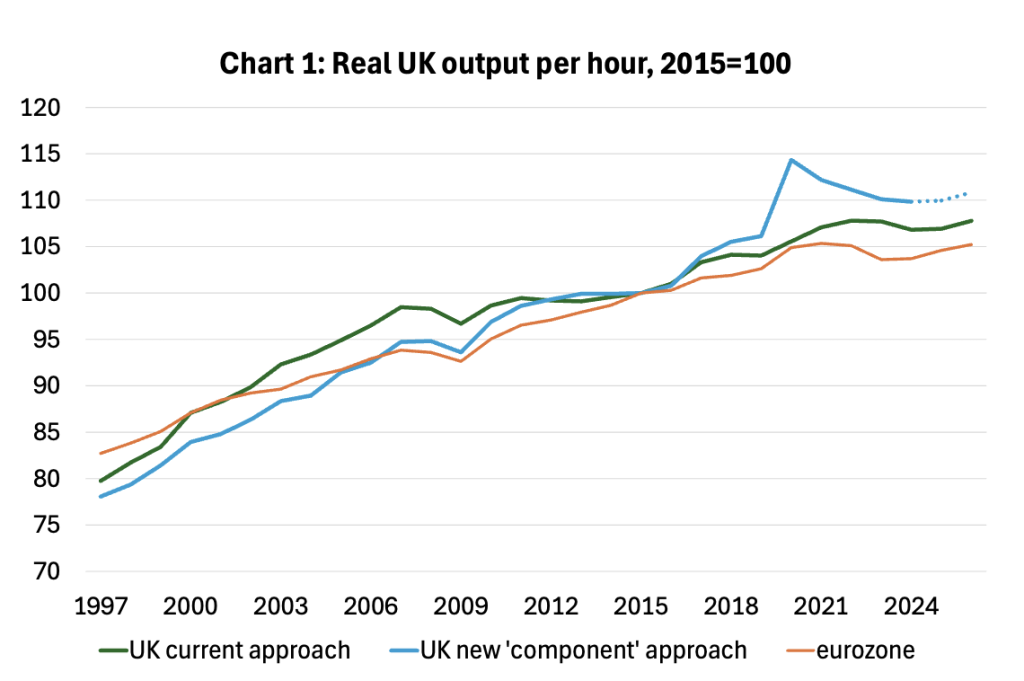
Sources: ONS, Eurostat.
Note: dotted lines are new ONS data extended with current approach data to mid-2026
This is a significant upgrade, both in absolute terms and relative to the UK’s peers among the advanced economies. Indeed, not only do the new UK data look much stronger than for the eurozone since 2015, they are also stronger than the equivalent figures for Canada and Japan. Only the US stands out with a much better productivity performance than all the other advanced economies (Chart 2).
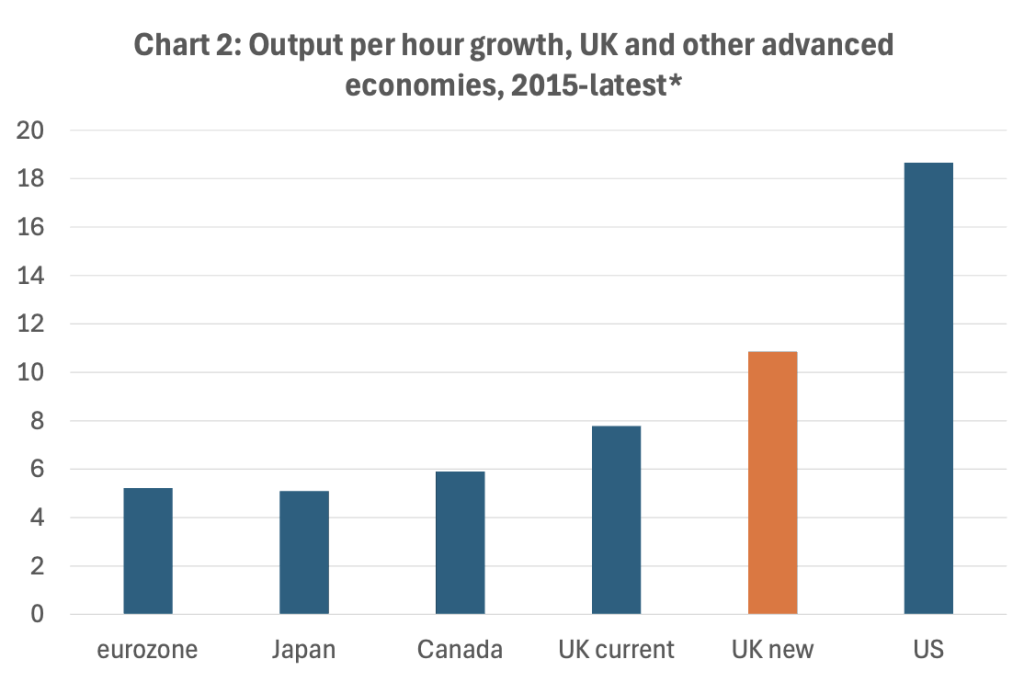
Sources: ONS, Eurostat, Statistics Canada, OECD, BEA * Japan data only available to 2024
It’s true that the UK still shows a notable slowdown in productivity growth compared to the period before the global financial crisis, but the new data show no evidence of any slowdown in the years since the Brexit referendum. The final data point in the new series is above an extrapolated trend line of productivity growth from 2007-2015, and our estimate of the level of productivity in mid-2026 is also slightly above this trend (Chart 3).

Source: ONS
Note: dotted lines are new ONS data extended with current approach data to mid-2026
These new data, then, represent a major blow to the popular media and political narrative of Brexit damaging UK productivity. To sustain that narrative, you would now need to claim that UK productivity growth in the absence of Brexit would for some reason have accelerated sharply after 2015 relative to its previous trend – despite all the negative economic shocks the UK has suffered in that period, including the sharp rise in energy prices relative to other economies and the deliberate run down of high productivity sectors like oil and gas extraction.
It is time once and for all to bury this misleading narrative which has no basis in the actual data.



